Search The Web

Monday, December 5, 2011

Action Research 2

1. What is the problem?
2. What is the rational for the project?
3. What strategy will be use to address the problem?
4. What is the question?
5. What evidence is presented that the strategy will work?
6. How will data be collected?

1. The problem in this action research is Rhyme and Word Recognition.
2.  "Learning to recognize rhyme and word families is a critical literacy skill that can help beginning readers develop recognition of phonems and decode new and difficult words."
3.  Simulations and Games
4.  "How can I use a variety of rhyming games to help my students recognize rhyme and word families in text?"
5. The researcher uses the article Integrated Strategies Approach: Making Word Identification Instruction Work for Beginning Readers as a supporting idea of implementing this method. 
6.  The student-teacher will assess the students before implementing the rhyming games.  Then, the assessment will be administered after the project.  This will be over a period of 4-weeks.  Students will participate in small group reading centers on a daily basis.  A checklist will also be used to evaluate student's ability to identify rhyme in pictures, sound, or text. 

Action Research 1

1. What is the title of the project?
2. What is the Question?
4. What strategy is being used to address?
5. What evidence is presented that the strategy will work?
6. How will data be collected to determine if the strategy will work?
7. How was the data analyzed?
8. What were the results?
9. How do the results inform teacher practice?
 
1. Getting Smarter at School
2. The question is how to create classrooms that allow students to be thinkers and problem solvers.
3. The strategy used was cooperative grouping.
4. The chart showed the results from the grouping.  It showed that by March students held less independent conversations and had discussion with the class.  Also students raised their hands more and asked questions.  It was easy to tell that the student seem to be more engaged as the teacher went on. 
5. Evidence present is the fact that the teacher who implemented this was somewhat successful after a few discussions later. 
6. The data was analyzed by making a graph. 
7. The results showed that more kids asked questions and less were involved with side converstions.  Also the number of students who talked out of turn went down a little. 
8.  I as a teacher, could ask my students the ways they feel they could learn the material and concepts.  I also would know that each situation is trial and error so all I need to do is decide whether my practice is successful or not. 

Monday, October 31, 2011

Anchor Video


Here is a video i found on Youtube I am using for my WebQuest on Shapes.

Thursday, October 27, 2011

Struggling Student

 Focus on struggling student.According to the learning style of interest survey how are the learning activities in the classroom meeting their needs?

The struggling student in my class is hardly ever in school.  When he is in class, he gives the math teacher a hard time about doing his work.  I asked if she has had this student before and she said no.  She told me that he transfered from a school in Morgantown.  He seems to have home troubles.  I didn't have him fill out the survey, but the only way that school meets his needs is to have one-on-one study with him in another classroom.  It seems to help and he seems to bond really well with teh special needs teacher. 

Monday, October 24, 2011

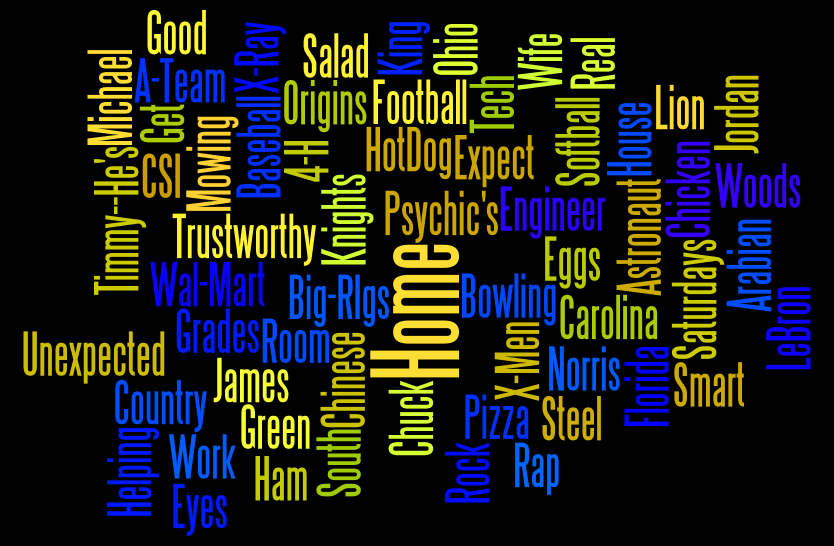
Interest Survey Wordle

I created a Wordle with the Interests of my students.

 
Here is a link to the Wordle Website

Wednesday, October 19, 2011

Double Entry Journal #15


1. Give an example of an authentic form of assessment the students engaged in a PBL performed well on?
One form of assessment mentioned is standarized testing.  The article mentions the fact that students who participated in a PBL scored higher on standarized testing.  Another form of assessment is the project students design when completing a PBL.  The article mentions of one PBL whose outcomes were judged and 84% of those outcomes were accurate enough to build.
2. How does project based learning promote intrinsic motivation?
Students have more choices available when it comes to the fact of a PBL.  These choices allow students to "develop their own interests and pursue deeper understanding."
3. What do students who experience PBL do better than student who receive traditional direct instruction?
Students do better in solving real-world problems.  They develop skills and knowledge based upon real-world experienced learned through PBLs. 
4. How does PBL align with John Dewey's philosophy of education?
Project based learning allows students to retain more information from learning by doing.  This is waht John Dewey proposed. 
5. Why do our assessment practices need to change if we are going to prepare students for the 21st century?
Assessment needs to change because the activities change.  Fill in the bubble tests may be great for reciting knowledge, but they do not test the students ability to perform the tasks.  Assessment needs to be designed to challenge the students skills as well as the knowledge they have. 

Monday, October 17, 2011

Double Entry Journal #14

What are some challenges to inquiry approaches to learning?
One challenge is the skills needed by the teacher in order to implement a different approach to learning.  He or she needs to be well informed of the benefits, outcomes,  or problems associated with the new type of learning.  Not knowing the material could lead to poor structure and chaos in the classroom.
What are the benefits of group work? Give two concrete examples from the reading.
Students are benefited in social skills, improvement in self-concept, time on task, positive feelins toward peers, and social interaction.
Name one strategy to support group work and find an example of that strategy on the Internet and link me to it.

Last part of #14

Name one strategy to support group work and find an example of that strategy on the Internet and link me to it.

Thursday, October 13, 2011

Questions asked by the teacher

"What is the answer to the problem of the day?"
Students answer the questions. 

"What is 7-5?"...2

The questions asked are simple, but yet it is math so I don't see how she could change much. 

Double Entry Journal Entry #13

1. Read the Introduction. What "dominant paradigm" is showing signs of wear?
The fact that although the world has evolved in many ways, the educational system has not.  The schools "remain caught in a web of educational thinking and systems that originated a century ago." 

2. According to the research, how does Project-Based Learning support student learning better than traditional approaches? Describe three benefits and cite the studies.
---"...students who engage in this approach benefit from gains in factual learing that are equivalent or superior to those of students who engange in traditional forms of instruction (Thomas, 2000).  This approach takes learning one step further.  Students are able to transfer their learning to new kinds of problems.   
---"...the students who engaged in project-based learnign demonstrated a significant increase in scores on a critical-thinking test (Shepherd, 1998)."
---"...those who had participated in the project-based curriculum did better on conceptual problems presented in theNational Exam (Boaler, 1997 1998)."

3.  According to the research, how does Problem-Based Learning support student learning better than traditional approaches? Describe three benefits and cite the studies.
---"...medical students who are enrolled in problem-based curricula score higher on clinicla problem-solving measures and on actual rating of clinical performance (Vernon & Blake, 1993; Albanese & Mitchell, 1993)..."
---"...students who participated in problem-based experiences are better able to generate accurate hypothesis and coherent explanations (Hmelo, 1998b; Schmidt et al., 1996)
---"They also experience larger gains in conceptual understanding in science (Williams, Hemstreet, Liu, & Smith, 1998)

4.  According to the research, how does Learning by Design support student learning better than traditional approaches? Describe three benefits and cite the studies.
---"...the design project led to better learning outcomes than the traditional approach to instruction (Hmelo, Holton, & Kolodner (2000). They also found that the design helped students view the respiratory system more "systemically."
---"...design activities are particularly good for helping students develop understanding of complex systems...(Perkins 1986).
---Higher and lower-achieving students showed stronger evidence of progress in learning the targets science concepts...(Fortus 2004). 

5. What are the differences between the three approaches?
Project-Based:
- this learning involves completing "complex tasks".  These lead to a more "realistic product".
Problem-Based:
-lessons involve a specific type of activity focused on using reasoning and resources to solve a problem.  Students work in small groups to "investigate meaningful problems."  They also create solutions and strategies.
Learning by Design:
-This approach involves the idea that children learn deeply when they are ased to create an "artifact." This artifact requires understanding and application of knowledge.  This approach alsi supports revisions on activites students create. 

6. In your opinion, what is the most important benefit to learning that is common across the three types of inquiry-based learning approaches?
The most important benefit to learning is that the current system needs to change.  All three types involve something different from what goes on today in the classroom.  The "paradigm" at the beginning is accurate and these types of learning, if implemented, can help shake that paradigm and give a new meaning to school and success.

Monday, October 10, 2011

Double Entry Journal #12 part2

In a blog posting tell how asking essential questions can improve learning in schools.


"Essential questions provide the link between students' lives and curriculum."  If we make the questions connect to the students rather than something pointless, the response could be greater and the effectiveness of teaching would be amazing.  Pulling students in is hard, asking the right questions lessens the challenge a bit.

Double Entry Journal #12 part1

Three things I learned.
*Language communicates control.  I never thought of it as such, but language does effect control in a given environment. 
*I learned that searching for the answer does not necessarily help the students engage in new ideas and concepts.  This idea makes sense, it is just hard to grasp since I plan to be a math teacher. 
*Another thing I learned is we need to value student knowledge more.  I sort of already knew this, but this statement just opened my eyes more.  If we give credit to kids for what they know rather than "complaining" about what they don't know, then the attention of the students might be easier to grasp. 
Two things I found interesting.
*We take language for granted.
*"A student who can provide an acceptable answer has not necessarily mastered learning." This is an accurate, powerful statement. 
One question I have.
*Since I am going to teach math, how do I get out of the "only one answer" trend, because essentially there is only one answer (so to speak). 


Wednesday, October 5, 2011

Double Entry Journal #11

Authenticity-Exemplary "There is external audience for the student work"  The Top Ten Wiki was public on the web so people around the world could vote for what they feel were the most dangerous animals. 

Applied Learning-Exemplary "Students apply new knowledge to a realistic problem."  Before the lesson began, the teacher went over with the students "facts" and "opinions".  They used this knowledge to determine that the Top Ten Dogs were based upon people's opinions. 

Active Exploration-Satisfactory "Students conduct their own research"  The students were required to find details about the animals they chose to list as the top ten most dangerous animals. They used computers and books to find these characteristics

CSOs Met:
RLA.O.4.1.3  use pre-reading strategies to comprehend text.
RLA.O.4.3.4 create an age appropriate media literacy product that reflects understanding of format, characteristics and purpose.
SC.O.4.1.6 support statements with facts found through research from various sources


Wednesday, September 28, 2011

Technology Survey

  • How many computers are in the classroom? 3
  • Do they have internet access? Yes
  • Can you access Google Tools? Yes
  • Do you have access to a laptop cart? Yes...Can they get on the Internet? Yes
  • Is there a computer lab? Yes
  • Do the Computers have Internet Access? Yes
  • Can you access Google Tools? Yes
  • How do you reserve it? Sign up on the calender.
  • How many of your students have computers with internet access at home? 7th graders:19, 17 of which access internet.
  • Are there any locations in the community where students can access computers and Internet? No

Tuesday, September 27, 2011

Double Journal Entry #10

Why is kid watching a critical practice for teacher to use? How is kidwatching informed by cultural difference theory?
 
Kid watching keeps the teacher informed of the students.  As the intructor, he or she can keep up on how the students learn and what setting is best for them when it comes to learning.
 
Watching kids also gives a teacher information about where they are from.  Kids tend to implement skills and actions learned from home into their school environment.  Essentially, kids from different cultures will learn differently and can be monitored by teachers.  The teacher can also create a setting that is suitable for many cultures and can be beneficial to a students learning. 

Sunday, September 25, 2011

Double Entry #9

Why is it important to encourage students to use primary language or code switch during literacy events? Does this apply to children with Appalachian dialects? Why or Why not?
It is important because children who know literacy in their own language already know the importance of literacy and how it can be applied to other aspects of life.  Also, allowing students to go between languages help them become more "savvy."  It can to some aspect.  The Appalachian dialect is different and affects the language for the kids.  Allowing for the dialect to help assist with the teaching of a new language. 
What are the differences between reading aloud from a students centered perspective and a teacher centered perspective?
The conversation that occurs is different.  If it is teacher-centered, then the conversation is more goal-directed to where lessons can come about.  If the conversation is student directed, then the goals can be learned on their own, rathter than directed.
Find a resource for using Appalachian literature in the classroom.
Here is the mission of a website that I found dealing with Appalachian Literature.
"The mission of the Appalachian Studies Association is to promote and engage dialogue, research, scholarship, education, creative expression, and action among scholars, educators, practitioners, grassroots activists, students, individuals, groups and institutions. Our mission is driven by our commitment to foster quality of life, democratic participation and appreciation of Appalachian experiences regionally, nationally and internationally."
Here is the link 
 

Wednesday, September 21, 2011

Journal #8

Why is it a mistake to group all English as Second Learners together? Give three reasons and examples from the reading in a blog posting.  One is the cooperation among the students.  The example is how Bianca "didn't remember" how to say something in spanish.  This caused Rosa to fall behind.  Another reason is because it sets the students apart and secludes them from other English-Speaking students.  Bianca's mom wanting Bianca to "fit in" emphasizes the need and want of children who aren't "normal".  One final error this can cause is the teacher does not know the different cultural backgrounds of the "English as Second Learners".  The article supplies two different locations that provide spanish speaking students. (Texas and Honduras).  This can cause communication errors and may lead to more separation of the foreign students. 

What is a virtual backpack and how does it relate to Funds of Knowledge?
Virtual backpacks are full of things that students have already learned.  This can be things at home, with friends, and from the world they live in.  Students bring with them skills, values, and assumptions.  This relates to "Funds of Knowledge" because it incorporates what Moll was talking about.  This includes the idea of bringing what the child knows and incorporating it into the lesson or classroom.   

Find a resource related to teaching English as a Second language? Here is a site to a program that teaches english as a foreign/second language.

Wednesday, September 14, 2011

Sunday, September 11, 2011

Double Entry Journal #6

A cultural activity I took place in was the West Virginia Symphony, held at the Fairmont State Campus.  The symphony was a requirement for my music class.  I actually enjoyed it.  It was nice to see and hear the different types of music, classical music.  It took dedication and learning on the people's part to ensure they got the quality of the music down.

Related Resource:
I found a website about a program centered around cultural responsive teaching.
LINK